
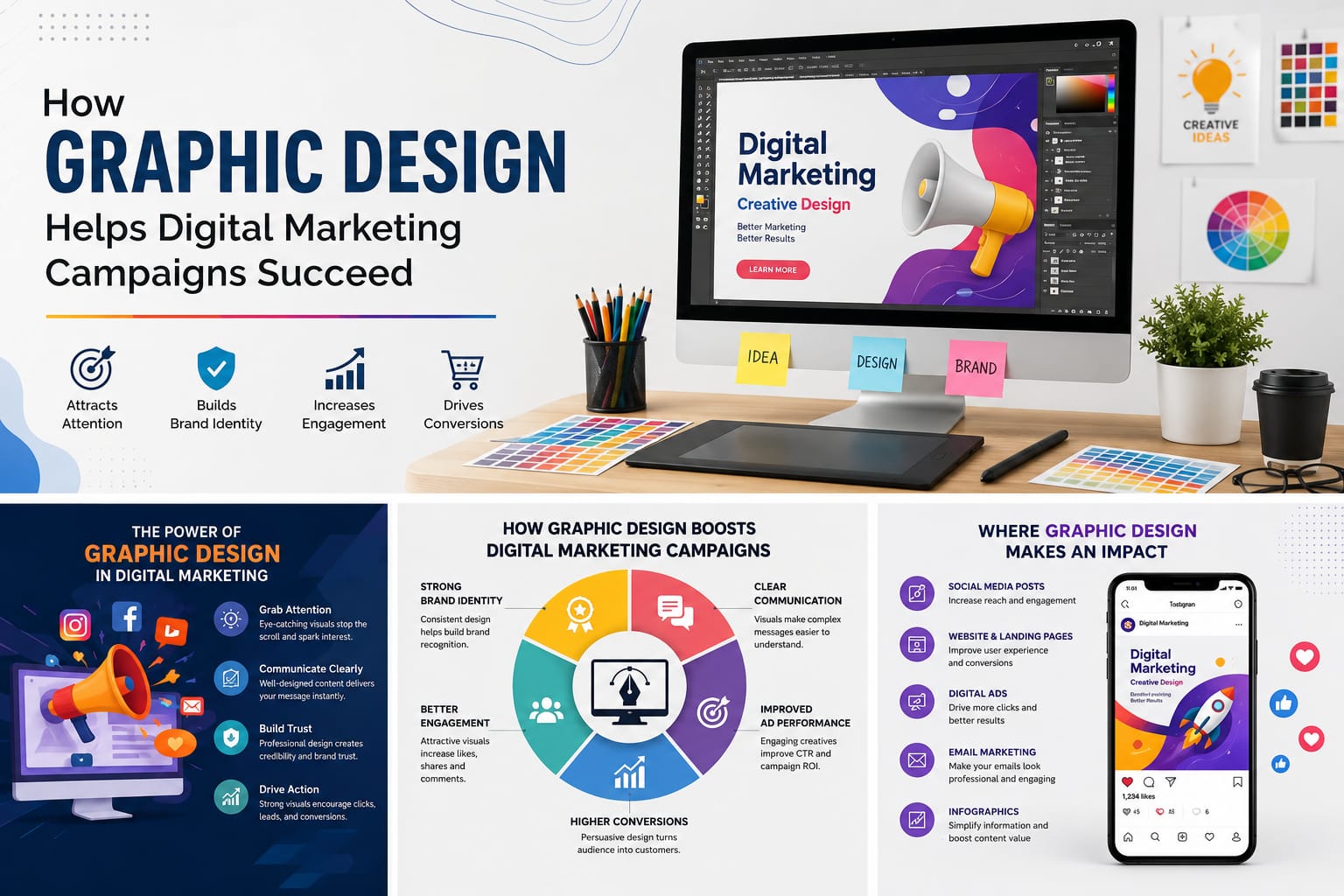
Graphic design helps digital marketing by improving brand recognition, social media engagement, advertising communication, website usability, and visual content quality.
After providing the direct answer, the article can explain each benefit in greater detail.
This structure is useful because both human readers and answer engines can quickly identify the key information.
In today’s digital-first business environment, attracting customers requires more than simply publishing content online. Businesses need strong visuals, consistent branding, engaging social media creatives, and effective digital marketing strategies to stand out in a competitive marketplace. This is where Graphic Design and Digital Marketing work together.
Graphic design communicates a brand’s message visually, while digital marketing helps deliver that message to the right audience through search engines, social media, websites, email marketing, paid advertising, and other online channels. When these two disciplines are combined strategically, businesses can improve brand recognition, engagement, website traffic, leads, and conversions.
What Is the Role of Graphic Design in Digital Marketing?
Graphic design is the process of communicating ideas and information through visual elements such as images, typography, colors, layouts, illustrations, icons, and graphics.
Digital marketing uses online channels to promote products, services, and brands. Graphic design makes digital marketing content visually attractive and easier to understand.
For example, a digital marketing campaign may include:
- Social media posts
- Website banners
- Google Ads creatives
- Landing page graphics
- Email marketing designs
- Infographics
- Promotional videos and thumbnails
- Blog illustrations
- Brand identity materials
Good design helps users notice the content, understand the message, and take the desired action.
1. Graphic Design Creates a Strong Brand Identity
Brand identity plays an important role in digital marketing success. A professional logo, consistent color palette, typography, imagery, and visual style help customers recognize a business across different digital platforms.
When the same visual identity appears on a website, Instagram page, advertisements, emails, and marketing materials, the brand becomes more memorable.
For example, a company can maintain consistency by using:
- The same brand colors
- Consistent fonts
- A recognizable logo
- Similar image styles
- Consistent social media templates
- A clear visual communication style
This consistency can strengthen brand recognition and help businesses build trust with their target audience.
2. Visual Content Increases Social Media Engagement
Social media is highly visual. Users scroll through large amounts of content every day, so businesses have only a short opportunity to capture attention.
Well-designed social media graphics can make marketing messages easier to notice and understand.
Graphic designers can create:
- Instagram posts
- Instagram Stories
- Reels covers
- Facebook advertisements
- LinkedIn graphics
- YouTube thumbnails
- Promotional banners
- Educational carousels
However, attractive design alone is not enough. Successful social media creatives should combine visual appeal with a clear marketing message and strong call to action.
For example, instead of simply displaying a product image, a promotional design can communicate the product benefit, offer, and action the customer should take.
3. Graphic Design Improves Website User Experience
Website design directly affects how visitors interact with a business online.
A website with confusing layouts, excessive graphics, inconsistent fonts, or poor visual hierarchy can make information difficult to find. Professional graphic design helps organize information and guide users through the website.
Important design elements include:
- Clear navigation
- Visual hierarchy
- Readable typography
- Proper spacing
- Relevant images
- Mobile-friendly layouts
- Clear calls to action
- Consistent branding
Good visual hierarchy tells users what they should notice first, second, and third. This can make the customer journey more intuitive.
4. Design Makes Advertising More Effective
Digital advertising depends heavily on creative presentation. Whether a business uses search ads, display advertising, social media advertising, or other paid campaigns, the creative needs to communicate the message quickly.
Effective advertising graphics generally include:
- A clear headline
- Relevant imagery
- Strong brand identification
- One primary message
- A compelling benefit
- A clear call to action
A professional graphic can support the marketing objective by making an advertisement easier to understand.
Businesses can also test different creative variations to determine which visual approach performs better with their target audience.
5. Graphic Design Supports Content Marketing
Content marketing is not limited to written articles. Visual content can make educational and informational material easier to consume.
For example, a blog about digital marketing can include:
- Infographics
- Charts
- Process diagrams
- Statistics graphics
- Illustrations
- Comparison graphics
- Step-by-step visuals
These elements can break long sections of text into easier-to-understand pieces.
Visual content can also improve the shareability of useful information on social media and other digital platforms.
6. Graphic Design Builds Customer Trust
Professional presentation can influence how customers perceive a business.
A website or social media profile with consistent and carefully designed visual content can create a more professional brand experience.
On the other hand, inconsistent designs, low-quality images, unclear typography, and poorly arranged layouts can make a business appear less professional.
Therefore, graphic design should not be considered only decoration. It is an important part of brand communication.
Best Practices for a Successful Digital Marketing Campaign
For maximum impact, businesses should treat design and marketing as one integrated process.
Start with audience research and identify what customers need. Then develop a clear marketing message.
Next, create visual content that communicates that message effectively.
Finally, optimize the supporting content for SEO, GEO and AEO.
The process can be:
Audience Research → Marketing Strategy → Content Creation → Graphic Design → SEO Optimization → GEO/AEO Optimization → Publishing → Performance Analysis
This approach helps businesses create content that is attractive, useful and discoverable.
How does graphic design help digital marketing?
Graphic design improves visual communication, brand recognition, social media engagement, advertising creatives, website presentation and content readability.
Is graphic design important for SEO?
Yes, indirectly. Optimized visuals can improve user experience, content engagement and accessibility. Image optimization can also provide search engines with additional context.
What is GEO in digital marketing?
GEO, or Generative Engine Optimization, focuses on creating content that is useful and understandable for AI-powered search and generative answer systems.
What is AEO in digital marketing?
AEO, or Answer Engine Optimization, focuses on providing clear answers to questions users ask through search engines and answer-oriented platforms.
Can graphic design and digital marketing be combined?
Yes. Graphic design provides the visual communication while digital marketing provides the strategy for reaching and converting the target audience.
Why is visual content important for social media marketing?
Visual content can attract attention quickly, communicate information efficiently and strengthen brand recognition across social platforms.
Conclusion
Graphic design is much more than creating attractive images. It is an important communication tool that can strengthen digital marketing campaigns, improve brand recognition and make information easier to understand.